



rounded image of attorney Andrew Mathis

Can COPD Qualify You for Disability in Baltimore, DC, and Virginia?

CONTACT US FOR A FREE CONSULTATION

    Get Social Security Disability Financial Assistance when You Can’t Work

    You’ve worked hard and paid into Social Security for years. But chronic obstructive pulmonary disease (COPD) has made it impossible to work, and you’re worried about your finances and your future.

    Social Security Disability benefits can cover you with COPD, providing vital financial relief, but getting your disability claim approved isn’t simple.

    More than 11 million people in the U.S. have COPD. They don’t all have symptoms debilitating enough to qualify for disability benefits. The challenge is proving your case is one that does.

    Most people get denied when they first apply for Social Security Disability. It’s tricky to get a claim approved when it’s for an illness that varies so widely in severity, like COPD.

    You shouldn’t try to win benefits on your own. Talk to our Alexandria disability advocates and see how we can help you.

    The team at Mathis & Mathis Disability Advocates has helped thousands of people over the last 30 years. We’re ready to support you at every step of this process, from your initial application for benefits to appealing a denial.

    The Social Security Administration (SSA) has high standards for disability benefits, but our experienced advocates know what it takes to make a claim successful. You pay no fee until you win benefits.

    We are exclusively focused on helping people win disability benefits when they’re stressed about their health and finances in Maryland, Washington, D.C., Northern Virginia and across the country.

    Social Security Disability Is All We Do.

    Read more »
    Call Us Today! » Call Us Today! »

    When Social Security Considers COPD a Disability

    To win disability benefits, you must prove you can’t work because of severe health issues.

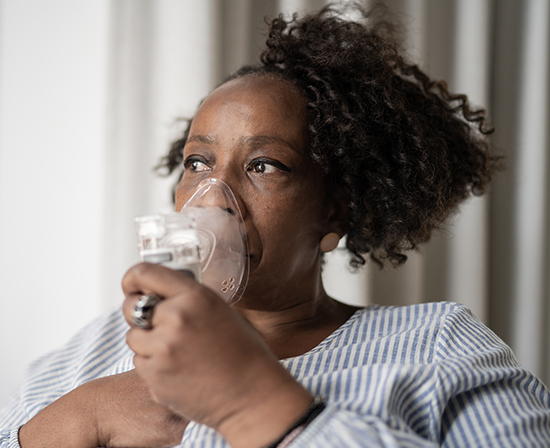
    People with COPD suffer from a variety of symptoms that can interfere with their ability to work, even in jobs that aren’t thought of as physically demanding.

    COPD symptoms that could cause problems during the workday include:

    • Shortness of breath
    • Constant coughing
    • Fatigue
    • Chest tightness
    • Dizziness or fainting
    • Frequent respiratory infections
    • Periodic need for hospitalization

    Just having these symptoms won’t be enough. COPD is a qualifying impairment in the SSA “Blue Book” official listing of impairments, meaning there is a specific way of evaluating disability claims for this respiratory disorder.

    A claims examiner could classify your COPD as an eligible disability if you meet one of the following benchmarks:

    • A forced expiratory volume (FEV1) equal to or lower than the minimum for your height, age and sex—how strongly you can breathe out
    • A forced vital capacity (FVC) less than or equal to the minimum for your height, age and sex—how much you can breathe out
    • Chronic impairment of gas exchange as demonstrated by diffusing capacity of the lungs for carbon monoxide (DLCO) measurements or an arterial blood gas (ABG) test—how well oxygen gets from your lungs to your bloodstream
    • Complications that have required three hospitalizations within 12 months, with at least 30 days between stays lasting 48 hours or more

    How do you show you meet the standards set by Social Security, and what can you do if you don’t meet the specific criteria laid out above?

    Our Northern Virginia disability advocates can answer your questions and help you make your claim as convincing as possible.

    Get a FREE disability claim evaluation.

    Read more »

    How to Claim Social Security Disability for COPD

    The SSA wants to see evidence when it evaluates your COPD disability claim. We mentioned medical tests above, but those results aren’t the only things that can help your case.

    It also helps to show how your COPD symptoms affect you in your everyday life. The more evidence you can give, the stronger your case for benefits will be.

    Our Baltimore, Virginia, and Washington, D.C. disability advocates can help you gather items like:

    • Results of DLCO tests, spirometry, pulse oximetry and other medical tests
    • Hospitalization records
    • Information about treatments, their effects, and whether you’ve stuck to treatment plans
    • Records from physical exams
    • Statements from family members, friends and coworkers who have witnessed your health struggles
    • Evidence of disruption to your work, like missed days or a need for reduced workloads

    You should also provide evidence of any other ailments you suffer from. Some other health issues that commonly come with COPD include diabetesdepression, and chronic bronchitis or emphysema.

    One of the biggest obstacles facing anyone applying for disability benefits is that Social Security doesn’t just need to see that you can’t work at your current or most recent job.

    Your claim needs to show that you won’t be able to work any job for 12 months or longer.

    When Social Security evaluates your claim, it uses a measurement known as residual functional capacity (RFC) to assess what kind of work-related activity you could handle, ranging from sedentary to very heavy.

    Let’s say that you’re struggling to do your job because of your COPD. A claims examiner might look at your disability claim and acknowledge your struggles, but they think that you can do sedentary or light work instead of the heavy work you’ve been doing.

    This means your claim will be denied. If Social Security thinks you can just do another job, you won’t win disability benefits.

    Get our experienced disability advocates on your side, ready to help you make the argument that your current job isn’t the issue, and that your health prevents you from working any job.

    Read more »

    Do I Need an Alexandria Disability Advocate?

    Some people think applying for disability just means filling out some SSA forms and submitting a few medical records, but this isn’t an easy process to do on your own.

    Winning Social Security Disability benefits is a lot of work in the best circumstances. You should focus on your health and let our disability advocates help you.

    The team at Mathis & Mathis can help you:

    • Figure out if you qualify for disability benefits
    • Fill out your initial application
    • Stay aware of important deadlines
    • Gather important medical evidence that can strengthen your claim
    • Avoid errors that could delay or endanger your benefits
    • Appeal if your disability claim gets denied
    • Prepare for your disability hearing in front of an administrative law judge
    • Make sure, at every step, that your claim is being well taken care of

    The advocates at our family disability advocate firm can answer any questions you have. We’ll even follow up to make sure you’re getting the benefits you’re supposed to after you’ve won your case.

    We know how difficult this is. You didn’t ask to develop health problems that stop you from working and supporting yourself.

    Mathis & Mathis Social Security Disability advocates are dedicated to you and your disability claim. Let us help you fight for the benefits you deserve, so you can rest and take care of yourself.

    Contact Us Today.

    Read more »

    Applying or Appealing, We Can Help

    Whether you’re in the initial stages of applying, appealing a denial of benefits, or wondering if you qualify, Mathis & Mathis can help.

    Hear from a Mathis & Mathis Client

    “I could not recommend Mathis & Mathis highly enough. They were kind, patient and thorough. No question was too small. They were timely in responding to me. While the process of applying for and obtaining disability is a long, tough road, Mr. Mathis made everything so much better. If you are thinking about applying, please do and know you will be taken very good care of . . . just like family.”

    —  Tracey Jones, Google Reviews